
AI support becomes risky when the bot tries to finish every conversation. The strongest teams design the opposite: a clear escalation playbook that tells the assistant when to answer, when to ask one more question, and when to hand the case to a human with full context.
Escalation is part of the product
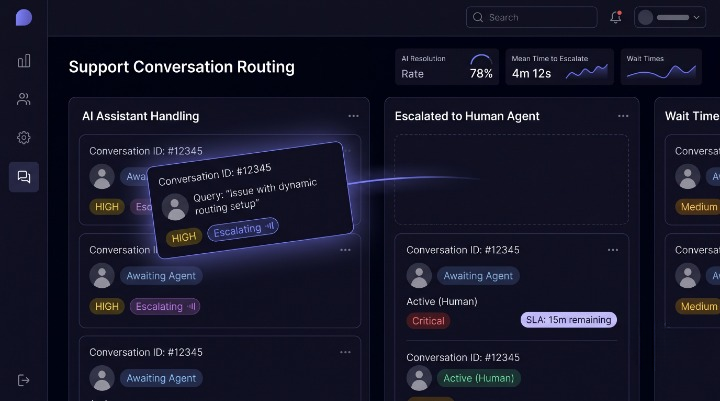
A handoff is not a failure state. It is a product behavior. Customers do not mind automation when it saves time, but they lose trust quickly when the assistant keeps circling around a sensitive or unresolved issue.
The practical goal is simple: let AI handle predictable work and make complex work easier for the human agent who receives it.
Five signals that should trigger a handoff
Risk. Billing disputes, legal requests, account access, cancellations, security reports, and compliance questions should move to a human queue unless your internal policy explicitly allows automation.
Confidence. If retrieval returns weak or conflicting knowledge, the assistant should say less, summarize what it knows, and escalate instead of guessing.
Emotion. Anger, panic, repeated frustration, or phrases like "I have already tried this" are operational signals. They usually mean the customer needs ownership, not another generated answer.
Business value. High-value accounts, expansion conversations, renewal risk, and active sales opportunities deserve a human touch faster than low-risk FAQ traffic.
Looping. If the customer asks the same thing twice or rejects the answer once, the bot should not keep trying the same path. Escalate with the last attempted resolution attached.
Build a matrix, not a vague rule
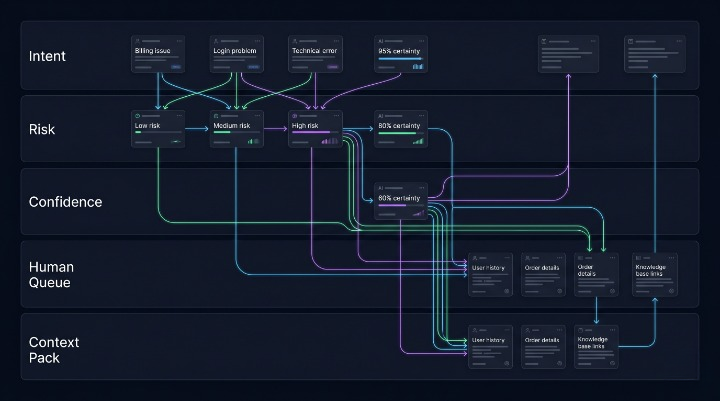
The easiest way to operationalize escalation is a small matrix with five columns: intent, AI action, human queue, context package, and SLA. This keeps product, support, and engineering aligned on what the assistant is allowed to do.
For example, "invoice copy" can be fully automated. "Invoice is wrong" should collect invoice ID, summarize the dispute, and route to billing. "Account compromised" should stop automation immediately and route to security with priority.
The customer should feel the handoff as continuity, not a restart.
The context package matters most
Do not send agents a raw transcript and call it a handoff. A useful escalation package includes the detected intent, customer summary, account state, answers already attempted, documents used, confidence score, and recommended next step.
This is where AI creates leverage even when it does not resolve the case. A human agent starts from a prepared brief instead of reconstructing the conversation from scratch.
A 14-day rollout
Days 1-3: review the last 200 support conversations and tag every case that should have escalated earlier. Days 4-6: create escalation rules for the top ten risky intents. Days 7-10: define context packages and queue ownership. Days 11-14: pilot the playbook with one support queue and review missed escalations daily.
Measure the result with escalation accuracy, time to resolution, reopened tickets, and customer satisfaction after handoff. If those improve, your AI is not just faster. It is becoming operationally safer.
Ready to implement AI support?
Start your free trial of Specteron today and see the difference.
Get started